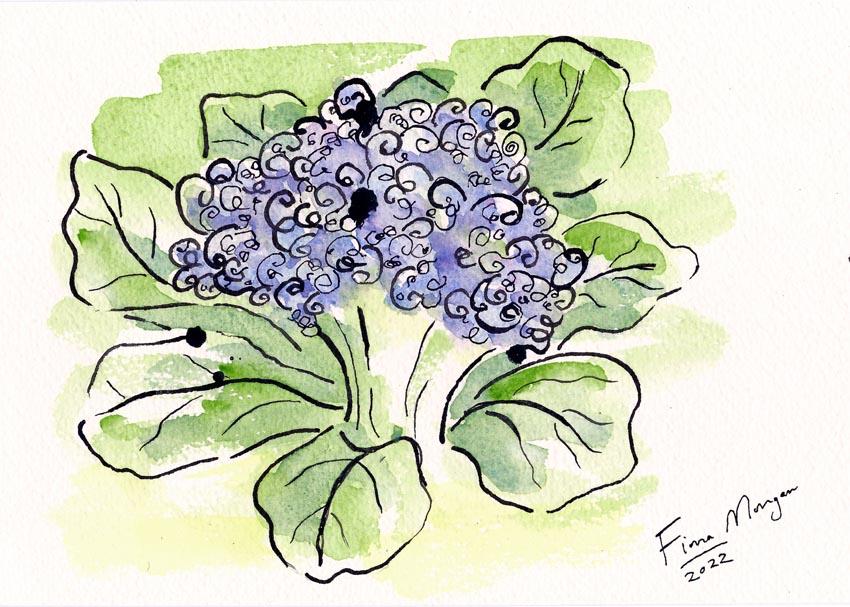
Broccoli & cauliflower
Mar 10, 2026
Hearty cool season treats. Most parts are tasty and edible – the heads and leaves and the younger stem parts. The flowers are edible but meh. Older stems are too tough. That makes for a lot of food and broccoli especially is very nutritious. Broccoli is easy to grow in this area, given enough food, water and light. Cauliflower is included here more because the growing conditions are so similar. It is a fussy, difficult veg to grow well and dislikes the heat of this area.
New articles are available directly via email – sign up at http://eepurl.com/hakBgT
Broccoli
Brassica oleracea var. italica
Home grown broccoli is nothing like what comes from the stupidmarket, in the same way home grown tomatoes are like a completely different food to their store version. Although they are not beginner plants, broccoli, and broccolini are relatively easy to grow – in the cooler months only. Too many cabbage moths when it’s warm, and as most brassicas, is prone to bolting in warm weather.
These plants need a much bigger spacing than you might expect (40-100cm!) and they are HUNGRY plants. Hungry for plenty of nitrogen early on before fruiting, and hungry for as many daylight hours as possible. If your garden is in shade by mid afternoon in the cool season, you won’t have enough light to grow these. Fruiting veg need far more light to grow successfully than leafy veg.
Which varieties to grow here?
The broccoli in the store are varieties which tend to grow a single large head only. F1 hybrids are known to be more reliable than open pollinated for these. Commercially the single big head types are planted weekly to ensure a continuous supply. A lot of work!
In the home garden, it’s better to skip these and look for warm climate broccoli varieties that are known for sprouting side shoots (treat as broccolini) after a main head is grown or varieties that are sprouting varieties only (they don’t make a main head at all, just lots of broccolini). Plant a small batch or three of these spread out over the season. Then, enjoy the heads when they come and feast for weeks and weeks on a near endless supply of side shoots until the warmth arrives and broccoli season is over. Much less work for far more food compared to constantly planting for the single big broccoli head. There are many suitable choices for this approach, ie Italian Green Sprouting and others. Kailaan / gai lan / Chinese broccoli (Brassica oleracea var. alboglabra) actually works really well as a sprouting broccoli too.
FYI, Romanesco broccoli is actually a cauliflower! Don’t be caught out.
The broccoli head we eat is actually tightly packed immature flower buds on the growing tip of the stem. Leave this growing too long and the buds loosen and burst into bright yellow bee-attracting flowers. The side shoots / broccolini are mini versions of the main head. Side shoots are formed lower down the stem, and after the main head has been harvested. Once the weather warms up, the plant tends to skip the stage of tightly packed immature flower buds altogether and bolts straight to creating loose and leggy bouquets of flowers. So cooler weather is required for our broccoli and broccolini stage.
Sow from mid Feb and stop May – July. They will grow well through to October, when they begin to just bolt.
A mature broccoli head will take 2 – 3 months from sowing to harvest. If you want continuous harvesting of big heads over the season, plant every week or two. If your variety takes 2 months to mature, it needs to be harvested by the end of September, so work backwards for your last planting date. That’s end of July at the latest. For a 4 month long maturation, the last planting is end of May.
Broccoli seeds will germinate over a wide soil temperature range, from 5° to 35°C. The optimum range is 20° to 28°C. Broccoli grows best under cool conditions. The optimum temperature range for growth is 15° to 21°C with day temperatures of 3° – 35°C as their limit. They’re quite forgiving. However, night temperatures over 15°C reduce both quality and yield. Mature broccoli, but not young growth, can cope with light frosts but temperatures of -5°C or lower can damage heads and will kill young seedlings. There are also varieties bred to cope with even colder temperatures which we don’t get here.
Seeds are best sown in trays and transplanted out once they have at least 2 sets of true leaves (3 sets of leaves in total). Remove the first pair of leaves, the cotyledons or seed leaves, and plant deep, up to the first set of true leaves. This builds a stronger root system. The plants tend to have quite shallow roots. These are big plants. Usually 50 to 70 cm tall, and nearly as wide. Some varieties can take up a metre of space! Plant 40 cm apart with rows 60 cm apart as a general guide.
This plant prefers a mean annual rainfall in the range 900 – 1,500mm, but tolerates 350 – 2,000mm. They need full sun. They DO NOT tolerate shade. Also, good drainage, regular water, and fertile soil. They prefer a heavy soil, slightly acidic. pH in the range 6 to 6.5, tolerant of 5.5 – 8.5. Ok forcoastal gardens. Notably, they will succeed in any reasonable soil. Hooray!
Broccoli is a heavy feeder.
Prep your soil before planting. They like a good helping of all the major plant nutrients, plus boron and molybdenum. Create a feed mix from what you can of compost, manure, fish meal, seaweed, blood & bone. Once in the ground and growing, everyone has a different fertiliser schedule to recommend, but most growers will feed either liquid seaweed or fish / blood & bone quite regularly – every week or three from about the 6 leaf stage, or give second a big solid fertiliser feed after the seedlings are around 6 weeks old, and another midway through their growing season.
They like quite a bit of nitrogen especially in the earlier leafy stages of growing. Failure to give them enough N to make plenty of healthy leaves means they will not create as much broccoli over their lifetime and no amount of N later on will make up for this. Pee near your broccoli plants, they like it. Plant snowpeas or sugarsnap peas nearby.
These plants are shallow rooted, especially for their size, and so susceptible to water stress. Keep them evenly watered for continuous supply of tasty food and healthy plants. Usually broccoli, being quite tall, can out compete most weeds.
Broccoli seed saving is possible though not for beginners. They are large plants, cross pollinate with many other brassicas that you or your neighbours may have within 2km (cabbage, brussel sprouts, cauliflower, kohlrabi, kale) and you’ll need to keep 2-6 plants. In our climate they may go to seed at the end of their first year even though they are biennials. Cooler places than us definitely need to wait an extra year for seed.
Cauliflower
Brassica oleracea var. botrytis
The primadonna cousin of broccoli. A tricky veg to grow well, and especially in warmer climates, including in this area:
- Cauliflower will throw a hissy fit if they encounter less than ideal conditions or care;
- The interval between perfect and an unappealing and tasteless, though edible, head of bolted flowers instead of a head of cauliflower can be one day;
- A short run of warmer temperatures or a week of colder temperatures, especially while the cauliflower head / curd is forming will disrupt the curd creation and trigger flowering instead.
Drama queens. This is not a food plant built for resilience.
So, although they can be grown here, many professional growers don’t bother as the plants are too fussy to be reliable and take up a lot of garden space. The window of ideal growing season is also much narrower than for broccoli.
If you still want to have a crack at them, follow the growing advice for broccoli, with these variations and pointers:
As these are challenging to grow, small and quick maturing varieties are a better bet. Definitely look for warm climate tolerant varieties. Unfortunately, F1 hybrids are known to be more reliable than open pollinated. There are several Snowball cultivars that are grown successfully in warm climates, also Sixty Days. All of these grow smaller heads and should be ready in around 2 months. Phenomenal Early was also mentioned as a good one from a very experienced grower. It takes 4 months and grows a large head. There are Romanesco and purple varieties that can be grown here too. Unlike broccoli, once you pick the main cauliflower head, that tends to be it. Sometimes there will be little side shoots later. Only sometimes they will be worth eating. The leaves and stalks are perfectly edible as long as they are tender enough. Roasts, soups and casseroles are good for these.
Start planting from late Feb / early March, a little later than for broccoli. As these only grow one main curd, continuous planting to May – July depending on how long they need to mature, is the way to get a continuous supply.
Cauliflower seeds will also germinate over a wide soil temperature range, from 7° to 29°C. The optimum range is 20° to 28°C. They are forgiving with germination at least! For growing conditions cauliflower prefers mild to warm days, 18° to 30°C, and cool nights, 10° to 15°C. They can tolerate light frosts to -5°C but curds can be severely damaged at -2°C. Cold temperatures and lack of sunlight, ie overcast days, in the seedling stage can result in a seedling who won’t ever form a curd!
This plant prefers a mean annual rainfall in the range 600 – 1,100mm, but tolerates 450 – 1,900mm. They need full sun, good drainage, regular water, and very fertile soil that holds moisture. pH in the range 6 to 7, tolerant of 5.5 – 8.5. Ok for coastal gardens.
Sow and feed as for broccoli. When planting out, know that cauliflower can be larger than broccoli. 50 to 80 cm tall, and nearly as wide. Plant 40 cm apart in rows 60 – 75 cm apart.
Uncontrollable climate conditions and seasonal timing aside, the key to cauliflower is in feeding them well. Grow them quickly. The longer they sit around, the more likely there will be trouble. Prep the soil before planting. They need plenty of nutrients, especially N, but an overly nitrogen rich feed can cause sappy growth which attracts pests and is susceptible to cold damage. Fussy!
Curd creation is beginning when new leaves first grow upright. These then fold together in a spiral to protect the developing curd. In general, this only occurs after plants have passed a critical stage in their leaf growth. In short maturing varieties that are best to try here, this typically happens after the plant has formed 15 to 20 leaves.
To keep the curds white, they need to be kept out of the sun. However the plant itself needs full sun, so the curd usually has some of the big leaves tied shut around it. A little piece of shadecloth would do the same job. In hot weather the curds turn yellow quite quickly, or even an unappetising brown colour and the heat on them encourages them to loosen, turn ‘ricey’ (when you see it, you’ll know), and then bolt into flowers. So cover them up! The cauliflower curd that we eat is the stage just before flowering. Once the curd starts forming, things move quickly. Check on them daily. As soon as there’s a nice tight curd, harvest. It will probably be smaller than you’re used to. Or as soon as you see the curds beginning to loosen, harvest immediately. Tomorrow will be too late. You will have a bouquet instead.
Saving seed from cauliflower is not for those with small gardens. They set seed in their second year and are large plants. Unless you get great caulis and you’re a confident and careful seed saver, it’s probably not worth it. Being tricky to grow, you don’t want to save from a line that is anything other than optimal for your conditions, and being a brassica, they cross with many other brassicas.
For info on cabbage moth, the main pest of broccoli & cauliflower, see the Brassicas & Cabbage Moth article. Sometimes rats can be a problem. They can develop a liking for cauliflower curds! As if growing caulis wasn’t hard enough…
Big thanks to
Camilla from Autarky Farm, Carole Helman & Phil Gilmour, Daisy Dollisson, Harry Campbell from Pollinate Permaculture, Jeff Holmes, John Hodgkinson, John Vernon and the Bellingen Seedsavers blog, Kyles Woodbury formerly of The Vegie Gardener, Nick Radford from Bellingen Permaculture, Nicole and Matt from Dolly’s Run, Paul from Barefoot Fruit & Veg, Pete Bufo
References
Brassicas
1. Dimsey R, Carey D, Henderson SA. Brassica Best Practice – Integrated Pest Management [Internet]. Department of Primary Industries, Queensland; 2010 [cited 2025 Jul 12]. Available from: https://ausveg.com.au/app/data/technical-insights/docs/TL197.pdf
2. Heisswolf S. Brassica information kit (2004) [Internet]. Department of Primary Industries, Queensland; 2004. Available from: https://era.dpi.qld.gov.au/id/eprint/1965/5/brassica-grower5.pdf
3. Yara Australia [Internet]. 2018 [cited 2025 Jul 12]. Vegetable Brassica advice. Available from: https://www.yara.com.au/crop-nutrition/vegetable-brassicas/how-crop-nutrition-affects-vegetable-brassicas/
4. Fanton M& J. The Seed Savers Handbook. The Seed Savers’ Network; 2008.
Broccoli
5. Fern K. Useful Temperate Plants [Internet]. [cited 2025 Jul 12]. Brassica oleracea italica. Available from: https://temperate.theferns.info/viewtropical.php?id=Brassica+oleracea+italica
6. Woodrow L. First of the Season Broccoli. The Witches Kitchen [Internet]. 2023 May 12 [cited 2025 Aug 18]. Available from: https://witcheskitchen.com.au/first-of-the-season-broccoli/
7. Green Harvest [Internet]. [cited 2025 Jul 12]. Broccoli. Available from: https://greenharvest.com.au/collections/broccoli
8. Greenpatch Organic Seeds [Internet]. [cited 2025 Aug 12]. Broccoli – Umpqua. Available from: https://greenpatchseeds.com.au/products/broccoli-umpqua
9. Green Harvest [Internet]. [cited 2025 Jul 12]. Broccoli “Di Ciccio.” Available from: https://greenharvest.com.au/products/broccoli-di-ciccio
10. Green Harvest [Internet]. [cited 2025 Jul 12]. Broccoli “Green Sprouting Calabrese.” Available from: https://greenharvest.com.au/products/broccoli-green-sprouting-calabrese
11. Southern Harvest [Internet]. [cited 2025 Jul 12]. BROCCOLI ‘Green Magic’ F1. Available from: https://www.southernharvest.com.au/products/broccoli-green-magic-f1
12. Green Harvest [Internet]. [cited 2025 Jul 12]. Spigariello Liscia “Leaf Broccoli.” Available from: https://greenharvest.com.au/products/spigariello-liscia-leaf-broccoli
Cauliflower
13. Fern K. Useful Temperate Plants [Internet]. [cited 2025 Jul 12]. Brassica oleracea botrytis. Available from: https://temperate.theferns.info/viewtropical.php?id=Brassica+oleracea+botrytis
14. Valencia M. Cauliflower Growing – a “how to” guide for big heads. Self Sufficient Me [Internet]. 2015 Mar 15 [cited 2025 Jul 30]. Available from: https://selfsufficientme.com/farming/cauliflower-growing-a-how-to-guide-for-big-heads/
15. Green Harvest [Internet]. [cited 2025 Jul 12]. Cauliflower. Available from: https://greenharvest.com.au/collections/cauliflower
16. Eden Seeds [Internet]. [cited 2025 Jul 29]. Cauliflower – First Early Seeds. Available from: https://www.edenseeds.com.au/Product-Info-Seeds?product=cauliflower-first-early
17. Happy Valley Seeds [Internet]. [cited 2025 Jul 29]. Cauliflower – Phenomenal Early seeds. Available from: https://www.happyvalleyseeds.com.au/products/cauliflower-phenomenal-early-seeds
18. Green Harvest [Internet]. [cited 2025 Jul 12]. Cauliflower “Snowball Improved.” Available from: https://greenharvest.com.au/products/cauliflower-snowball-improved
19. Green Harvest [Internet]. [cited 2025 Jul 12]. Cauliflower “Violet Sicilian.” Available from: https://greenharvest.com.au/products/cauliflower-violet-sicilian
20. Yara Australia [Internet]. 2020 [cited 2025 Jul 12]. Nutrient deficiencies-Cauliflower. Available from: https://www.yara.com.au/crop-nutrition/vegetable-brassicas/nutrient-deficiencies-cauliflower/
21. Love of Dirt [Internet]. 2021 [cited 2025 Jul 30]. Growing Cauliflower in the Subtropics. Available from: https://loveofdirt.com.au/blogs/organic-gardening/growing-cauliflower-in-the-subtropics
22. Romanesco broccoli. In: Wikipedia [Internet]. 2024 [cited 2025 Jul 30]. Available from: https://en.wikipedia.org/w/index.php?title=Romanesco_broccoli&oldid=1260977380


