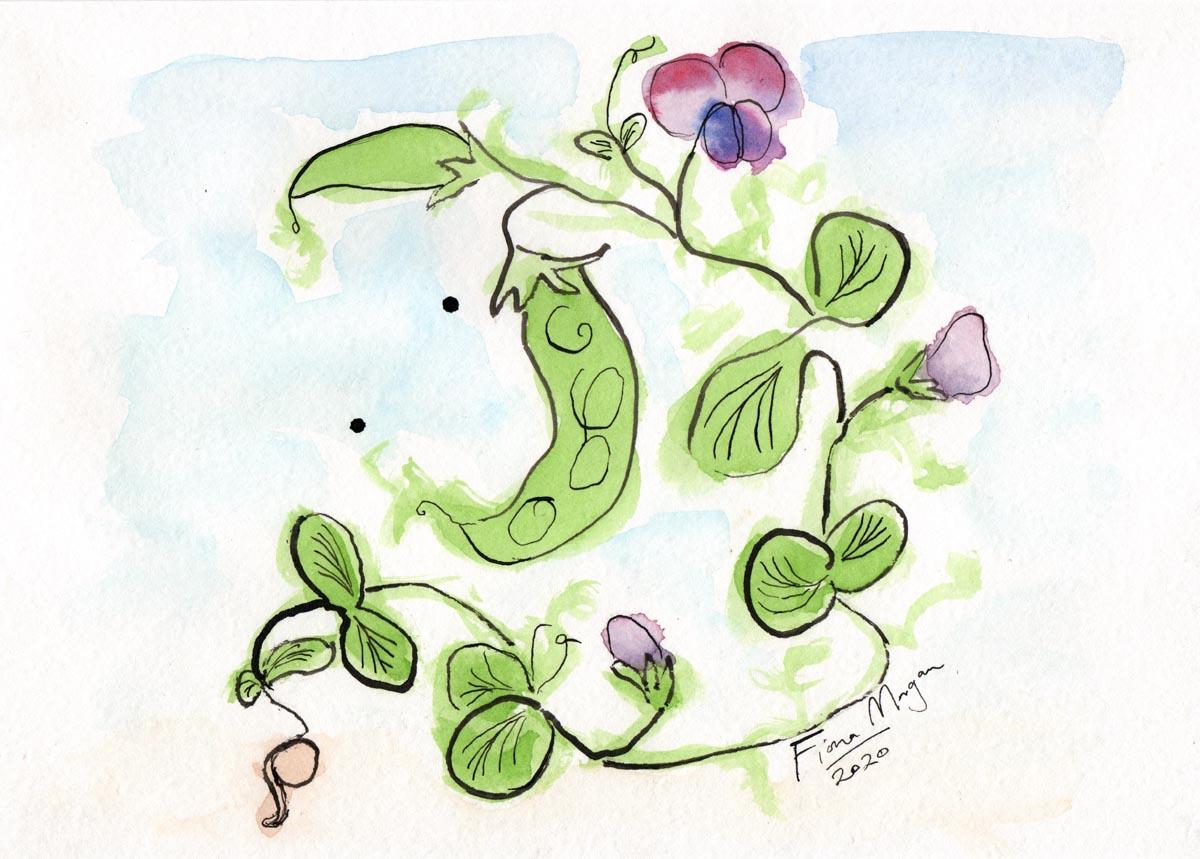
Peas – shelling peas, sugar snap peas and snow peas
While peas don’t tend to grow so well in the Bellinger valley area, snow peas and sugar snap peas are go! They are an easy plant to grow, abundant and can give tasty nutritious food over a long period of time in the cold season. You don’t need many plants to get a lot of food. When the pods start you’ll need to keep an eye on them daily because they grow so quick. You can eat the pods, the flowers and the young growing tips and leaves. Older leaves are edible but tough. The more you pick, the more this encourages the plant to grow. As nitrogen fixers they also improve the soil.
New articles are available directly via email – sign up at http://eepurl.com/hakBgT
With peas there are two main cultivars to note. Only one does well reliably in this area. What we commonly know as shelling peas, the ones found frozen in 1kg bags in supermarkets, the common little round green friends, Pisum sativum, are best skipped unless you can provide a particularly cold microclimate. The peas whose pods can be eaten, that’s sugar snap and snow peas, both Pisum sativum var. macrocarpum, are the ones that thrive here. As a bonus, no shelling required. Just pick and eat! They don’t even need cooking and are so sweet and moreish straight off the plant.
For maximum flavour it’s best to consume / process and freeze as soon as possible after picking. Like sweetcorn, the sweetness in peas diminishes with storage.
Shelling peas / garden peas / telephone peas
Pisum sativum
Generally it’s simply not cold enough for these to grow well here. They tend to do really well until about flowering time then suddenly wither to nothing. If you insist on giving these a go, the variety Green Feast / Lincoln (short vine or bush) was recommended by people who locally(ish) have places cold enough for successfully growing shelling peas. Another one was Maestro (bush). Both varieties are known to be more heat tolerant than others.
Snow peas
Pisum sativum var. macrocarpum
Snow peas tend to fruit continuously and need to be picked at least every 3 days. Under ideal conditions it takes about 8 to 10 days from flower pollination to full pod size! Snow peas are at their best when the pod is still young and flat, though they can be eaten older and plump too.
Varieties from warmer climates with wet autumns, such as some Japanese varieties, are perhaps best suited to this area. Yakumo Giant is one (vine). Oregon (vine) has been mentioned as good. A head’s up that the common snow pea variety, Melting Mammoth (vine), is known to succumb here to fungus just as it begins to fruit.
Sugar snap peas
Pisum sativum var. macrocarpum
Fun fact – sugar snap peas are a cross between a snow pea and a shelling pea. They snap like a green bean and the pods are thick and sweet and edible, all in one with the peas inside. The side strings need removing, that’s it. They are commonly harvested when the pods are fully developed – plump and green.
Recommended snap pea varieties were Bohemian (vine), which can take more heat than most and stays tender even when pods are large and older; Massey Gem (bush), which while not always tasty, is notably prolific and so needs attention to keeping good airflow around it to prevent moulds; and Cascadia (short vine).
The peas to success
First up, all of these are cold season plants. They don’t like heat. They will die off as the season warms up. Peas do best when day temperatures average 15° to 18°C, with a maximum of 24°C and a minimum of 7°C. Temperatures above 30°C will cause poor pollination (less fruit) and the plant to “mature early” ie to end it’s life cycle.
Sow from late April to the end of June. A cooler microclimate can extend this earlier and later by a couple of weeks. You need get them in with enough cool weather growing time (check your variety) for them to create an edible crop of pods for you to enjoy. The plants are dying off through October as the heat hits.
These are plants that need a trellis no matter how tall they will grow. Some of them will reach two metres high, some only half a metre. Set this up before you plant. So you know, different varieties fall in to three different growth habits: indeterminate (very tall / climbing / vine – fruit over 8 – 10 weeks and are generally more prolific overall), determinate (short / dwarf / bush – fruit all at once and are harvested in 2 – 3 batches over about 3 weeks), and semi determinate (taller bush / short vine – similar to determinate but not as extreme). Shorter varieties can be grown in pots or even hanging baskets! Successive plantings over the season are recommended to keep getting fruit.
Peas are easy to germinate from seed as most larger seeds are. Soak them overnight before planting (if you remember) and then do not water while you wait for them to come up. They rot easily. In fact, plant them into barely damp soil. Seeds germinate best between soil temperatures of 13 – 21°C and this takes about 7 – 10 days. 10°C soil temperature is the minimum for pea growth.
You will likely need to protect the germinating seed from the ravages of rodents and even bandicoots. There are a few approaches to achieve this:
-
Inoculation. They don’t need this to grow peas, but it does tend to speed up germination, and can increase the amount of pods and general plant health. Once germinated, the critters aren’t that interested. They may nibble the green tops but they don’t go for consuming the entire seed. Pre soak in an inoculant and compost / worm farm slurry overnight.
-
Sow in trays and transplant after about a month before the seedlings get leggy. They transplant really well, it’s just more work. In my experience the seed trays need to be in a rodent proof enclosure.
-
Sow direct and place a temporary cage over / around the seeds until they have sprouted. Something that neither mice or rats can get into. Push it into the soil a little way to discourage them from digging under too.
Choose a planting spot with full sun and sheltered from wind. The soil needs to be well drained as peas do not like standing in water. They will grow in most soils, but lovely fertile soil will give you much better results. What they most need is phosphorus (chook manure / bone meal / fish) and a slightly alkaline soil is their preference (6 – 7 pH, maybe add some lime several weeks before planting). As with many plants, too much nitrogen encourages lots of leaves instead of fruit (peas), especially for snow peas. Small amounts are ok.
Fungus. Humidity. Plant spacing. Airflow. Watering.
These are interrelated. Pea plants are susceptible to powdery mildew. As soon as the season warms pea plants get moulds which kill them. To reduce these kinds of fungal problems, try to avoid planting before periods of high humidity and plant in a spot with good airflow.
Plants can be spaced only 5cm apart, with rows only 45 – 60cm apart. When they are grown close together they can help support each other and crowd out weeds – peas don’t like weed competition. However, if you want to try extending their growing season as far as possible into the warm season, or ‘winter’ is a warm one this time, a wider spacing will give more airflow and less humidity which equals less moulds.
It’s also best to water the soil near their roots and avoid getting water on the leaves.
Once the peas have germinated, keep an even soil moisture, especially at flowering and fruiting time. Pea plants prefer a mean annual rainfall in the range 800 – 1,200mm, but tolerate 350 – 2,500mm.
The wait from sowing to picking delicious pods is 8 – 14 weeks, depending on the variety. It is a little slower during the depths of the cool season.
It’s worth knowing that frost will sterilise pea flowers! That means no pods from those frost hit flowers. Pods will get a white mottling from frost but are perfectly edible. Cold temperatures will cause pods to curl.
The only other thing to know is that fusarium wilt affects all pea types. It is a soil borne pathogen. There is no treatment and no cure. Infected plants will wilt and die and be a source of infection for the following pea planting. They should be pulled out asap and burnt (or bagged and red-binned). Do NOT compost or green-bin infected plants. There’s not much that can be done to avoid it. There are currently no resistant varieties. Keep the plants as healthy as you can and try not to replant in the same spot for a minimum of 3 years or even longer if that’s possible. Is it fusarium wilt? Check by slicing the stem of a suspiciously wilted plant longways at ground level and examine for a reddening inside the stem.
In better news, all the peas are easy to save seed from. They are an ideal plant to begin with seed saving. I like to mark the first and largest pods from the healthiest looking plants. Normal people might tie a ribbon or a twist tie on the pod stem as markers, but I like my annual chance to be like Alice in Wonderland and I head out into the garden with a paintbrush and some blue poster paint. I eat the other peas but not these ones. Let the marked pods stay on the plant until they turn brown and start rattling. Then harvest, make sure they are dry (don’t cook them!!) and store until next year in a cool dry spot that weevils and rodents can’t get into. If it’s rainy, harvest them early and dry inside as they will sprout in the wet pod if left otherwise! Then you’re on your way to your very own line of snow or sugar snap peas well adapted to your backyard.
Big thanks to
Carole Helman & Phil Gilmour, Daisy Dollisson, Ian Epic Earth from The Gourmet Garden School, Jeff Holmes, John Hodgkinson, John Vernon, Nicole and Matt from Dolly’s Run, Paul from Barefoot Fruit & Veg, Pete Bufo, Jeff Alcott.
References
Beckingham C. Agfact H8.1.35 – Snow peas and sugar snap peas [Internet]. NSW Agriculture; 2001 [cited 2025 Jun 28]. Available from: https://www.dpi.nsw.gov.au/__data/assets/pdf_file/0006/126339/Snow-peas-and-sugar-snap-peas-Agfact-H8.1.35.pdf
Burt J. Growing snow peas and sugar snaps in Western Australia [Internet]. Department of Agriculture and Food Western Australia; 2005 [cited 2025 Jul 2]. Available from: https://ausveg.com.au/app/data/technical-insights/docs/f05099.pdf
Fern K. Useful Tropical Plants. [cited 2025 Jun 30]. Pisum sativum. Available from: https://tropical.theferns.info/viewtropical.php?id=Pisum+sativum
L.S. Pavek P. PEA – Plant Fact Sheet [Internet]. United States Department of Agriculture; 2012 [cited 2025 Jun 30]. Available from: https://plants.usda.gov/DocumentLibrary/factsheet/pdf/fs_pisa6.pdf
Ossowski P. Eden Seeds Gardening Articles [Internet]. [cited 2025 Jun 29]. Available from: https://www.edenseeds.com.au/gardening-article?blogposturl=pea
Schuh M, Johnson A, Grabowski M, Orshinsky A. University of Minnesota Extension. [cited 2025 Jun 29]. Fusarium wilt. Available from: https://extension.umn.edu/disease-management/fusarium-wilt
Watson A, Yousiph A, Liew DrE, Duff J. PRIMEFACT 971 – Management options for fusarium wilt of snow peas [Internet]. Department of Industry and Investment NSW; 2009 [cited 2025 Jun 29]. Available from: https://www.dpi.nsw.gov.au/__data/assets/pdf_file/0003/228036/Management-options-for-Fusarium-wilt-of-snow-peas.pdf
Fusarium Fact Sheet [Internet]. Premium Crops; [cited 2025 Jun 29]. Available from: https://www.premiumcrops.com/files/Fusarium_growers_guide.pdf
Seeds Trust [Internet]. [cited 2025 Jun 30]. Maestro Peas. Available from: https://www.seedstrust.com/peas/peas-maestro
Eden Seeds [Internet]. [cited 2025 Jun 29]. Pea – Telephone Seeds. Available from: https://www.edenseeds.com.au/Product-Info-Seeds?product=pea-telephone
Green Harvest [Internet]. [cited 2025 Jun 29]. Pea “Greenfeast.” Available from: https://greenharvest.com.au/products/pea-greenfeast
Succeed Heirlooms [Internet]. [cited 2025 Jun 28]. Pea “Greenfeast” Seeds. Available from: https://www.succeedheirlooms.com.au/heirloom-vegetable-seed/heirloom-pea-seeds/pea-greenfeast.html
Green Harvest [Internet]. [cited 2025 Jul 8]. Pea “Massey Gem.” Available from: https://greenharvest.com.au/products/pea-massey-gem
Green Harvest [Internet]. [cited 2025 Jun 29]. Pea Snowpea “Yakumo.” Available from: https://greenharvest.com.au/products/pea-snowpea-yakumo
Snow pea. In: Wikipedia [Internet]. 2025 [cited 2025 Jun 29]. Available from: https://en.wikipedia.org/w/index.php?title=Snow_pea&oldid=1293146386