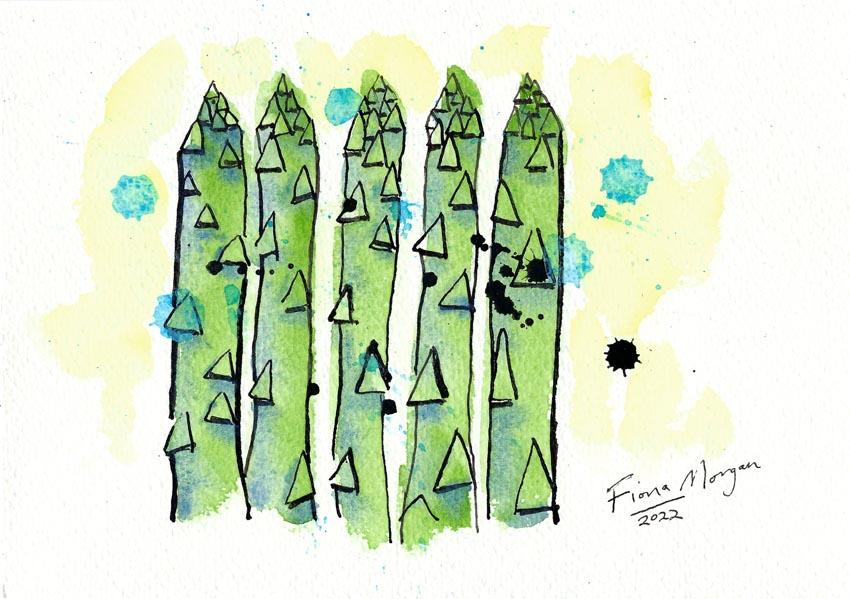
Asparagus
Asparagus officinalis
Asparagus is a very low maintenance perennial who will provide platefuls of delicious seasonal treats in the early warming part of the year (spring) right in that interlude where the cool season veg are winding down and before the warm season food plants have gotten going. This will go on every year for 10 – 20 years in exchange for an annual tune up (and being put in the right spot to begin with). This is a beginner friendly plant with almost no pests or diseases. Although this is a vegetable, asparagus needs to be approached like a fruit tree. Expect to plant and invest in care for a few years before tasting any results.
New articles are available directly via email – sign up at http://eepurl.com/hakBgT
Asparagus is a maritime Mediterranean-climate plant. They grow best in areas where annual daytime temperatures are within the range 15 – 30°C, but can tolerate 6 – 38°C. So they may appreciate some protection on super hot days here. They prefer a mean annual rainfall in the range 800 – 1200mm (less than this area), but thankfully they tolerate 500 – 4000mm with good drainage.
Asparagus thrives in regions with “cool winters” for dormancy. For healthy robust growth to take place, they require a dormant period of 90 – 150 days when temperatures are low. They also need a “warm spring” to trigger spear growth. Spear growth is best when the days are hot but nights are noticeably cooler. Frosts (-1°C) can damage spears, but by late August / early September when spears appear here, that shouldn’t be a problem. In summary, they grow well here, with one caveat….
Completely neglected asparagus do not seem to survive on their own in this area, unlike across a lot of the eastern seaboard of Australia where wild asparagus can be foraged. There is a distinct gap from about Port Macquarie to Lismore in the location maps of wild asparagus (Atlas of Living Australia), and a trend of reports from local home gardeners that their forgotten asparagus disappeared entirely.
So, it is recommended to set aside a distinct patch for asparagus in your garden. Somewhere that is easy to remember as the asparagus patch so it will get the annual tune up and otherwise be left alone. Physically mark it out if you need to. Asparagus hates competition. Especially in it’s first few years – just like many fruit trees. No grass. No weeds. Lots of mulch. Lots of compost and fertiliser.
You are looking for a spot in full sun where they will get no competition, no disturbance and that allows for great drainage and their deep roots. The patch will need to be easy to water regularly during the growing season. They will be tall plants at the height of the warm season and nothing but bare dirt in the cool season. A raised bed can be a good idea as it is conspicuous as a patch to be left undisturbed, and can help with drainage and providing space for the deep roots that will dive down an entire metre!
We probably need to run over how asparagus grows as it’s a bit unusual.
There are male plants and female plants. All of them are dormant and just a clump of hidden underground roots over the cool months. As the season warms they send up shoots. These are the spears we cut off and eat when they are about 20cm long. Left alone, the spears will keep growing and develop into a feathery fern up to 1.5m tall. This fern feeds the roots. Without this feeding the roots die. The fern creates flowers and the female plants create red berries, which are poisonous to humans. Yes the seeds in the berries can be saved to grow new plants. Large crowns (root balls) can also be divided when dormant.
Note. Asparagus plants need to be at least 3 years old before they are strong enough to withstand regular harvesting of their early spears.
Beginning your asparagus patch.
How many plants? Good question. Each plant will create between 10 and 40 spears per (8 week) season once mature. Or to put it another way, each plant will give you 1.25 – 5 spears per week over the 8 weeks of harvest time. Unless you’re lucky, it will be on the lower end of that estimate! It’s recommended to plant 12 asparagus plants per person to eat fresh spears 3 times a week, or plant 25 per person for daily consumption and preserving. Of course, this is space dependent too. Each plant should be given a space of 30cm2. Don’t skimp on space. They do better when they aren’t crowded. Male plants create more spears over the life of the plant, and the spears are smaller. Female plants create fewer spears but they tend to be larger and sweeter.
Seeds. Each red berry from the female plant contains around 6 seeds. From seed, a small delicate feathery seedling will grow. Sow seeds as the season is warming. A soil temperature of 25°C is ideal. That’s from about late September. Sow in containers. Seeds take around 3 weeks to germinate. Look after the seedlings (they will die back in the cool season) and plant out in their final position in the asparagus patch around the same time the following year. Now wait another 2 years before beginning to harvest!
Crowns. These look like the plant equivalent of a starfish. A bunch of fleshy roots radiating out from a central point. Obtaining crowns, at least 2 years old, is the fastest way to get your patch going. It saves you a couple of years of waiting. You should be able to begin to harvest the following year after planting 2 year old crowns.
Transplanting crowns is a job for when they are dormant ie in the cold part of the year. Around June – mid August. Each crown can simply be planted like any other plant, but to spread the roots out properly, dig a hole as deep as the length of the roots, plus 3cm. Then make a cone of soil inside the hole. A crown is placed atop this cone, with the roots spread out and around. However you get them in the ground, the top of the plant needs to sit about 3cm underground and be spaced 30cm apart from each other.
Regardless of whether you transplant seedlings or crowns, your asparagus patch needs to be prepared well. Their soil preference is for alkaline, moist but free draining, friable, and very fertile. Most soils around here will need some lime added as they are a bit acidic for this plant who prefers a pH of 6.5 – 7.5. Moist because asparagus likes constant access to water when growing. Well-drained soil is to prevent the crowns rotting, especially as we have a higher rainfall than is their preference. Friable so the long roots can grow easily. Very fertile as asparagus is actually quite a hungry plant and this was often remarked on in the interviews. Thankfully they only need one gluttonous feast of compost and aged manure (horse / cow / chook), maybe some blood and bone and / or seaweed, and good layer of mulch each year. Annual feeding is an absolute requirement!
Salt. Originally from maritime environments, the salt tolerance of asparagus is impressive. In fact, the Seed Savers Handbook recommends adding up to 30g / 6 teaspoons of salt to the soil per crown. As most other plants can’t cope with this, it has the added benefit of suppressing weeds too, which is great because asparagus does not cope with competition from other plants.
Any variety will grow fine. There is a recommendation from DPI NSW on organic asparagus production to look for Californian bred varieties over old European varieties as they cope with heat a lot better ie they stay as spears a little longer in our warmer temperatures before bolting into ferns. In practice, you will still need to be out checking and harvesting the patch daily in asparagus season. The spears grow really fast – sometimes 5cm a day! Even though this is a temperate climate plant, variety does not seem to really matter despite our warmer climate, according to the successful local home gardeners and those from areas even warmer than here.
Harvest time is from the beginning of September through to the end of October. The plants will keep pushing up spears, but after feasting for these couple of months, don’t be greedy, leave the plant alone to grow the rest of the spears into ferns. This is absolutely essential to keep the patch going for decades. The crowns need this photosynthesis energy to replenish and to stay alive for another year.
Remember, young plants are not strong enough to withstand harvesting. From 3 years of age, lightly harvest. Any spear thinner than a pencil should be left alone.
As you’ll probably be picking a spear or two each day and building up enough of a collection for a meal, the best way to store asparagus is to provide cool and humid conditions. Either stand the cut spears upright in a container with 1cm of cold water, cover and keep in the fridge, or wrap them in a damp tea towel, put this in a plastic bag and store in the vege crisper in the fridge.
Essential annual maintenance.
Warm season while the above ground parts are growing:
Keep watered.
From about November:
You’ve had two months of feasting and by now there should be other food plants becoming abundant. Leave the asparagus alone from now to grow their spears into ferns or risk losing the plant.
During the cool season when the plants are dormant and the ferns have died off.
Cut the dead ferns off at ground level. Use them as mulch or add to your compost.
Weed gently, if needed.
Add that gluttonous feast of compost and aged manure (horse / cow / chook), maybe some blood and bone and / or seaweed, and an inch or three of mulch. Water in well. You’re done for the year.
Big thanks to
Michele M, Carole Helman & Phil Gilmour, Daisy Dollisson, Harry Campbell from Pollinate Permaculture, Ian Epic Earth from The Gourmet Garden School, John Hodgkinson, John Vernon and the Bellingen Seedsavers blog, Kyles Woodbury formerly of The Vegie Gardener, Nick Radford from Bellingen Permaculture, Nicole and Matt from Dolly’s Run, Anna Frame.
References
1. Australia A of L. Atlas of Living Australia. [cited 2025 Sep 1]. Species: Asparagus officinalis (Asparagus). Available from: https://bie.ala.org.au/species/https://id.biodiversity.org.au/taxon/apni/51737699
2. Bonetto D. Wild Plants, Foraging, Food, Art and Culture. 2023 [cited 2025 Sep 1]. Learn how to forage for wild asparagus in Australia. Available from: https://www.diegobonetto.com/blog/stalking-the-wild-asparagus
3. Celia. How to Grow a Ton of Asparagus [Internet]. Self Sufficient Me. 2022 [cited 2025 Sep 1]. Available from: https://selfsufficientme.com/farming/how-to-grow-a-ton-of-asparagus/
4. Fanton M& J. The Seed Savers Handbook. The Seed Savers’ Network; 2008.
5. Fern K. Useful Temperate Plants. [cited 2025 Sep 6]. Asparagus officinalis – Useful Temperate Plants. Available from: https://temperate.theferns.info/viewtropical.php?id=Asparagus+officinalis
6. Neeson R. Organic Asparagus Production Agfact H8.3.5 [Internet]. NSW Agriculture; 2004. Available from: https://www.dpi.nsw.gov.au/__data/assets/pdf_file/0017/113417/organic-asparagus-production.pdf
7. T V. How much asparagus to plant per person [Internet]. Ask the Food Geek. 2023 [cited 2025 Sep 6]. Available from: https://askthefoodgeek.com/asparagus-plants-per-person/
8. Australian Asparagus Council [Internet]. [cited 2025 Sep 1]. AAC | About asparagus. Available from: https://www.asparagus.com.au/about-asparagus/index.php
9. Australian Asparagus Council [Internet]. [cited 2025 Sep 1]. AAC | Selecting and storing. Available from: https://www.asparagus.com.au/about-asparagus/selecting-and-storing.php
10. Australian Asparagus Council [Internet]. [cited 2025 Sep 1]. AAC | Varieties. Available from: https://www.asparagus.com.au/about-asparagus/varieties.php
11. Green Harvest [Internet]. [cited 2025 Sep 2]. Asparagus “UC 157.” Available from: https://greenharvest.com.au/products/asparagus-uc-157
12. Green Harvest [Internet]. [cited 2025 Sep 2]. Asparagus bed maintenance. Available from: https://greenharvest.com.au/blogs/earthwise-gardening/asparagus-bed-maintenance
13. Green Harvest [Internet]. [cited 2025 Sep 1]. Asparagus Growing Information. Available from: https://greenharvest.com.au/blogs/growing-information/asparagus-growing-information
14. MoMack Produce [Internet]. [cited 2025 Sep 1]. MACK Australia | Our Asparagus. Available from: https://www.momack.com.au/ourasparagus
15. Asparagus officinalis – environmental weed risk assessment 2022 [Internet]. Department of Primary Industries and Regional Development, Western Australia; 2022. Available from: https://library.dpird.wa.gov.au/cgi/viewcontent.cgi?article=1002&context=bs_wra
16. Establishing a Productive Asparagus Plantation in Australia [Internet]. Plant Needs Pty. Ltd. 2025 [cited 2025 Sep 1]. Available from: https://plantneeds.com.au/blog/2025/07/07/establishing-a-productive-asparagus-plantation-in-australia/
17. Asparagus. In: Wikipedia [Internet]. 2025 [cited 2025 Sep 1]. Available from: https://en.wikipedia.org/w/index.php?title=Asparagus&oldid=1308122654